

In Stock
Paintings
SKU: SKU-65
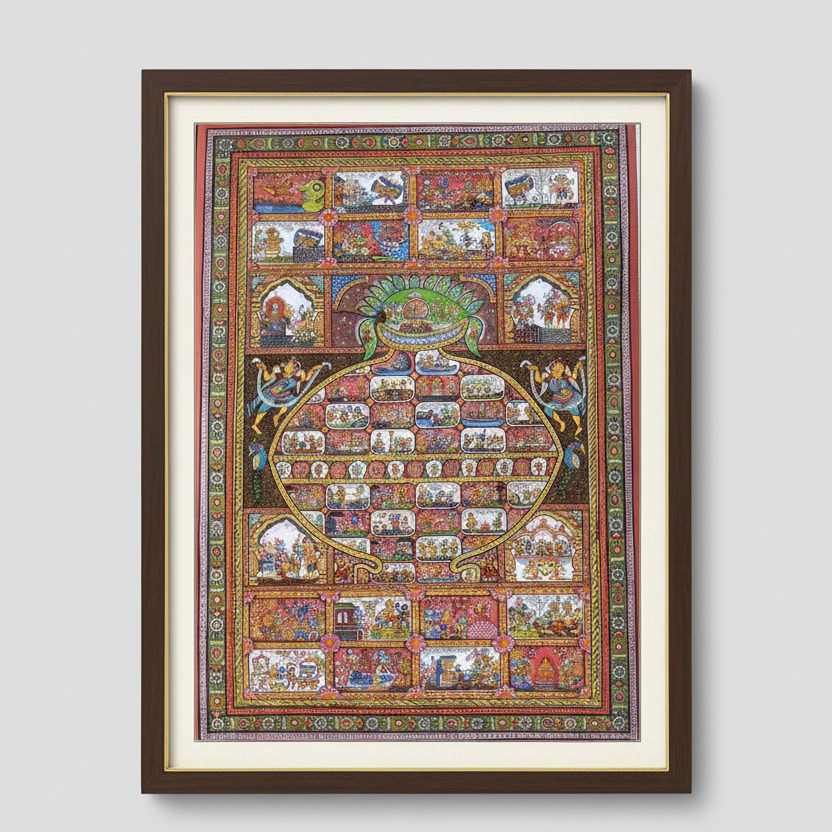
Pattachitra Painting – Samudra Manthan with Cosmic Tortoise Motif (Framed)
Narrative Pattachitra of the churning of the ocean; turtle and deities in miniature panels
grade
grade
grade
grade
grade
(0 Reviews)
Ask for Price
Hand-painted Pattachitra of the Samudra Manthan myth with Kurma the cosmic tortoise at center, surrounded by narrative medallions and deity panels; jewel-like vermilion and emerald palette. Framed.
This monumental Pattachitra brings to life the **Samudra Manthan**—the mythic churning of the cosmic ocean by gods and demons—organized around the form of **Kurma, the cosmic tortoise avatar of Vishnu**. The tortoise body, sprawling in the center, becomes a sacred diagram: its shell a stage for deities, its head an archway into narrative, its limbs extended into the frame. Surrounding the tortoise, miniature rectangular and circular panels unfold a cycle of myth: devas and asuras tugging Vasuki the serpent, celestial treasures rising from the churn, sages recording the drama, and Vishnu’s Kurma sustaining the mountain pivot. The panel becomes at once a story, a cosmogram, and a celebration of pattern.
The format is distinctive. Unlike single-icon compositions, this piece is encyclopedic. Concentric panels and border-bands read like a manuscript unrolled, where each square and medallion is a verse in pigment. The tortoise in the center is stylized with strong outlines and pattern-filled fields—scales rendered as latticework, shell plates tessellated with rosettes, limbs banded in floral cuffs. Above and around, bands of vermilion, emerald, and indigo ground miniature narratives, each dense with figures, props, and architecture. Yet despite the density, the painter’s discipline keeps clarity: each figure is proportionate, each gesture legible, each background balanced with breathing intervals.
The Samudra Manthan myth, beloved in Indian art, dramatizes the paradox of cooperation: gods and demons, usually adversaries, join to churn the ocean for amrita, the nectar of immortality. Mount Mandara is the pivot, Kurma is its base, Vasuki is the rope, and every treasure of the cosmos emerges in the process—Lakshmi, Kaustubha gem, Parijata tree, Kamadhenu, apsaras, and more. The artist here compresses all these appearances into a single frame, so that the painting becomes a time-lapse of myth. One can find Vishnu and Shiva attending, sages recording, apsaras dancing, elephants and horses rising, and in the corner, the dreaded Halahala poison consumed by Shiva. To live with this painting is to have an illustrated Purana at the wall.
Stylistically, the piece exemplifies the **Odishan narrative Pattachitra** mode: no empty space is left unconsidered, every inch is patterned with vines, checks, dots, or miniature scenes. Borders act as both closure and chorus: outermost bands carry bead chains, floral scrolls, and alternating geometric motifs, while inner bands tighten rhythm with lotus petals and creeper garlands. The rectangular format, slightly taller than wide, feels like a temple wall section cut and rehung in a frame. The cosmic tortoise grounds the composition: its calm presence and strong geometry anchor the swirl of myth around it.
The palette is saturated but harmonious. Vermilion fields carry warmth; turquoise and emerald cool them; indigo deepens recesses; conch-white highlights jewelry, eyes, and lotus stamens; lampblack cuts the fine hairlines that lace edges. The pigments are all traditional—ground stone and vegetable bound in natural gum—and they age with dignity, acquiring a matte glow rather than gloss. The discipline of flat color infill and white filigree rekha makes each panel legible even at distance.
For modern viewers, the painting offers two modes of encounter. From afar, one sees the cosmic tortoise holding the world of myth like a mandala. Up close, one can spend hours wandering panel to panel: watching devas strain on one side, asuras on the other; following Vasuki’s sinuous body through the coils; admiring the tiny jewelry of apsaras; discovering a sage bent over palm-leaf manuscripts. This ability to scale from icon to archive is what makes Pattachitra narrative pieces so absorbing: they can be both shrine and storybook, both icon and encyclopedia.
Placed in interiors, the painting is best given space. A central wall in a living room, a meditation hall, or a study will let it breathe. The frame—dark wood with ivory mount—is classic, but a gilded frame would also echo the treasure-theme. Lighting should be soft but sufficient: raking light can make the white dots sparkle, like foam on the ocean.
Care is simple: UV glazing, stable humidity, dust the glass not the surface, and if storing, keep flat and interleaved. Because it is hand-painted, small variations in border patterns, dot counts, or figure tilts are not defects but fingerprints of time and craft. They remind us that Samudra Manthan itself is not a mechanical churn but a dance of unequal forces, harmonized by attention.
In sum, this painting is more than décor. It is a myth compressed into pigment, a cosmos stabilized by a tortoise, and a devotional practice that invites the viewer to churn attention until nectar appears. As with the devas and asuras, the treasure here is not instant; it comes to those who stay with the painting, panel after panel, moment after moment.
| Material | Natural stone & vegetable pigments on hand-primed cotton (traditional Pattachitra) |
|---|---|
| Color | Vermilion, turquoise, emerald, indigo, gold-yellow, lampblack, conch-white |
| Weight | N/A |
| Dimensions | N/A x N/A x N/A |
| Brand | Artisan |
rate_review
No reviews yet. Be the first to share your thoughts!
Write a Review
Please log in to write a review.
Log InYou May Also Like
View All
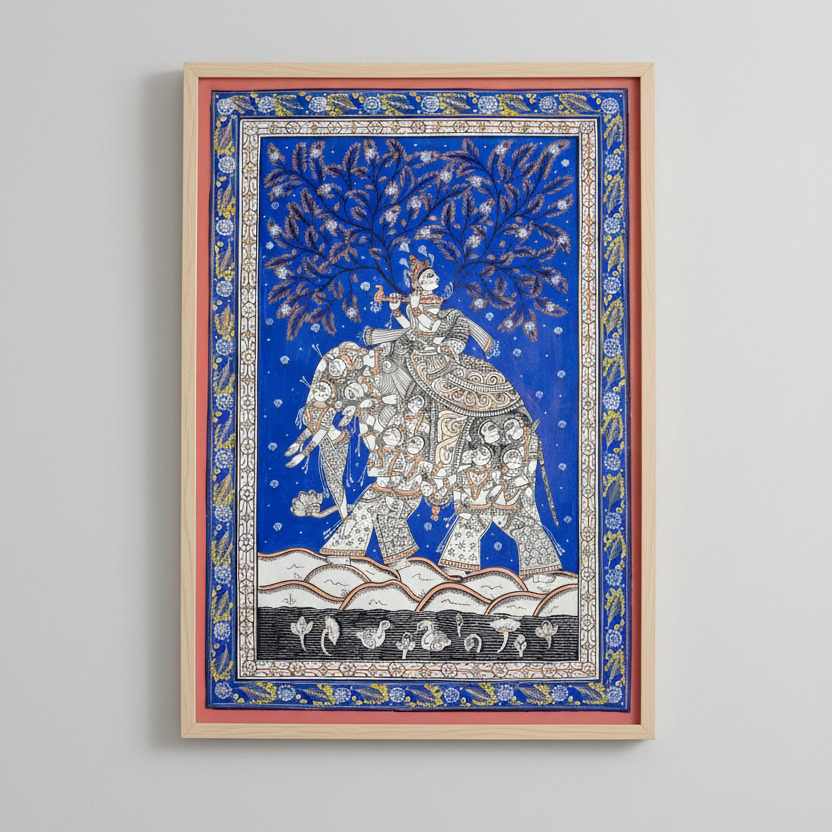
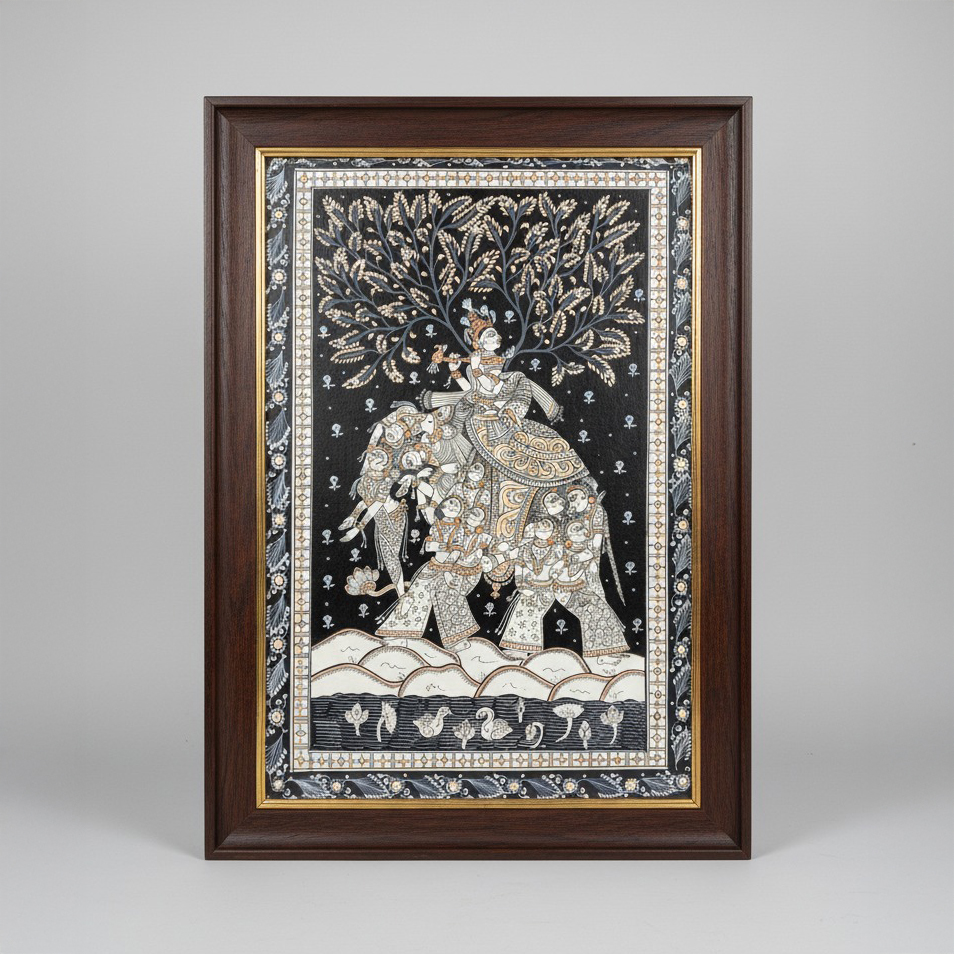
Monochrome Pattachitra – Royal Elephant Procession under Tree (Framed)
No reviews yet
Ask for Price