


Pattachitra Painting – Panchamukhi Ganesha in Temple Niche (Framed)

Handcrafted By
Niranjan MoharanaThis museum-grade Pattachitra painting portrays Panchamukhi Ganesha—Lord Ganesha with five serene faces—enshrined inside an ornate temple niche. Executed entirely by hand with natural stone and vegetable pigments, the composition celebrates the Odishan school of Pattachitra: a tradition renowned for its storytelling density, jewel-like palette, and lace-fine linework.… The central figure of Ganesha stands in tribhanga, his posture gently curved to suggest rhythm and auspicious movement. Each face corresponds to a distinct aspect of wisdom and protection, while the many arms display classical attributes: the modaka bowl of sweet insight, the parashu of resolve, the pasha and ankusha for gentle guidance, and the abhaya-mudra to quell fear. Surrounding him, celestial attendants, floral scrolls, and patterned draperies interlock like filigree—every inch of the surface activated by miniature motifs that reward slow, meditative looking.
Framing the deity is a vaulted mandapa rendered as an architectural stage. The painter stacks patterned cornices, lotus bands, and pillared cusps to create a shrine-within-a-shrine effect; this is a hallmark of Pattachitra design, where architectural borders are not mere frames but narrative spaces in themselves. Micro-ornaments—pearled garlands, moon-flower mandalas, and checkered lintels—are drafted with hairline strokes using a squirrel-hair brush. The palette draws from mineral sources: conch-shell white for highlights, lampblack glazed into the night sky, lac-tinted reds, and indigo-washed blues. Tiny dots—rekha and bindu—shimmer across the field like constellations, setting off Ganesha’s pale visage and coral robes.
While visually sumptuous, the iconography is disciplined and scripturally attentive. Ganesha’s vahana, the mouse, appears near the plinth, a reminder that great wisdom can inhabit the smallest of vessels; the mouse’s attentive gaze mirrors the devotee’s, bridging mortal sight to divine presence. The sacred thread (yajnopavita) runs across the belly, balancing worldly abundance with spiritual order. Five faces echo five directions and five pranas, while the circular halo and arch suggest cyclical time, rta, within which Ganesha unknots obstacles so that dharma can flow.
Technique and materiality are decisive here. Traditional Pattachitra begins by sizing cotton with a paste of tamarind seed and chalk, then polishing it to a vellum-like sheen. Pigments are hand-ground, bound with natural gums, and layered to achieve saturated planes that won’t fade easily. The artisan first lays out the figure in red-ochre underdrawing, then builds forms with opaque colors, reserving highlights for last. The characteristic white-and-black filigree—minute hatching and dotting—sharpens edges and lends a metallic glint without using metallic paint. Such manual density is not an indulgence; it is the narrative engine that turns a flat surface into a lit shrine.
A refined border anthology encloses the scene: upper registers parade beaded medallions and lotus cartouches, while the lower frieze alludes to guardians and musicians. These are not filler motifs—they calibrate visual rhythm, guiding the eye from periphery to sanctum. The painter’s control of negative space is noteworthy: between the stellar specks of the night sky and the calm blue niche, the white of conch-shell pigment glows as if lit from within. Even the floor tiles and textile drapes echo Odishan craft vocabularies—ikat chevrons, appliqué scallops, and temple textile borders—quietly situating the painting within a living ecosystem of regional artisanship.
As décor, the work is a showpiece: its vertical sanctuary format slots elegantly into entryways, prayer rooms, and study walls where a contemplative anchor is desired. As heritage, it is an education: a compact primer on how Eastern Indian painters translate theology into rhythm, proportion, and ornament. And as a gift, it carries the classic symbolism of Ganesha—the remover of obstacles—particularly apt for new homes, business ventures, exams, or creative beginnings. Displayed with a mount and light wood frame (as pictured), it reads modern while remaining staunchly traditional; the wide off-white mat gives breathing room so the intricate border-lace can sing.
Care is straightforward: avoid direct, harsh sunlight and high humidity; dust the glazing lightly with a soft cloth. If you prefer to reframe, choose acid-free mounts and UV-protective glazing to preserve the pigment brilliance for decades. Because every Pattachitra is hand-drafted—not block-printed—minor variations are marks of authorship, not flaws. In this piece, look closely at the halo beadwork and the mouse’s whiskers to appreciate the artisan’s steady hand. These are signatures etched not as names but as time spent in devotion.
Ultimately, this painting functions on three planes at once: as an object of aesthetic pleasure, as a devotional icon, and as a cultural document of a still-thriving atelier practice. Panchamukhi Ganesha, held within a cathedral of pattern, appears both intimate and cosmic, a reminder that clarity often arrives through patient attention—dot by dot, line by line—much like the way this painting itself came into being.
Niranjan Moharana
Niranjan Moharana is a highly acclaimed artist and National Awardee based in the Puri district of Odisha, India. His exceptional talent lies in his mastery of the traditional Pattachitra artwork, a form of art that originated in the state of Odisha.Niranjan's Pattachitra artwork is truly spectacular, featuring vibrant and intricate depictions of various mythological themes. These themes include depictions of the local deity Jagannath, as well as Ganesha dancing in Krishna's pose, Radha and Krishna, nature, and animals representing the incarnations of Vishnu.The Pattachitra art form is known for its use of natural dyes and handmade papers, which give each piece a unique and organic feel. Niranjan's expertise in this traditional art form has earned him widespread recognition and appreciation from art lovers and collectors alike.Niranjan's dedication to preserving the traditional Pattachitra artwork has also led him to train and mentor younger artists, ensuring that this beautiful art form continues to thrive for generations to come.Through his stunning artwork, Niranjan Moharana has not only put Puri district and Odisha on the map but has also helped to preserve and promote the rich cultural heritage of India.
View Artisan's Workshop & Collection arrow_forward100% Handcrafted
Made with time-honored traditional techniques by certified Indian master artisans.
Authentic Materials
Genuine natural materials sourced responsibly from indigenous Indian craft clusters.
Fair Trade Impact
Every purchase directly supports the livelihoods of traditional artisan families.
| Craft / Category | Paintings |
|---|---|
| Master Artisan | Niranjan Moharana |
| Material | Natural stone & vegetable pigments on hand-primed cotton (Pattachitra technique) |
| Color | Multicolor: vermilion, indigo, ochre, white, gold accents |
| Dimensions (L x W x H) | N/A x N/A x N/A cm |
| Weight | N/A g |
| Brand / Cluster | Artisan |
| SKU / Item Code | SKU-51 |
| Country of Origin | India |
No reviews yet. Be the first to share your thoughts!
Write a Review
Please log in to write a review.
Log InYou May Also Like
View All
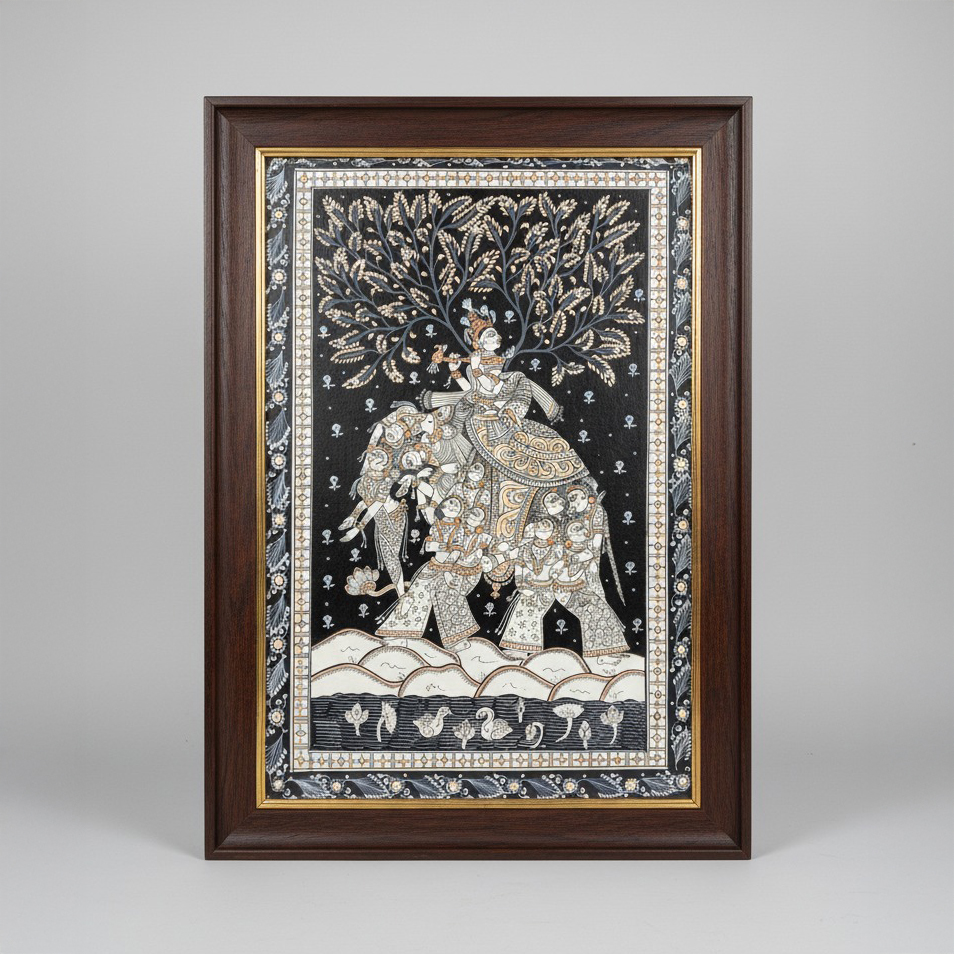
Monochrome Pattachitra – Royal Elephant Procession under Tree (Framed)
Ask for Price

