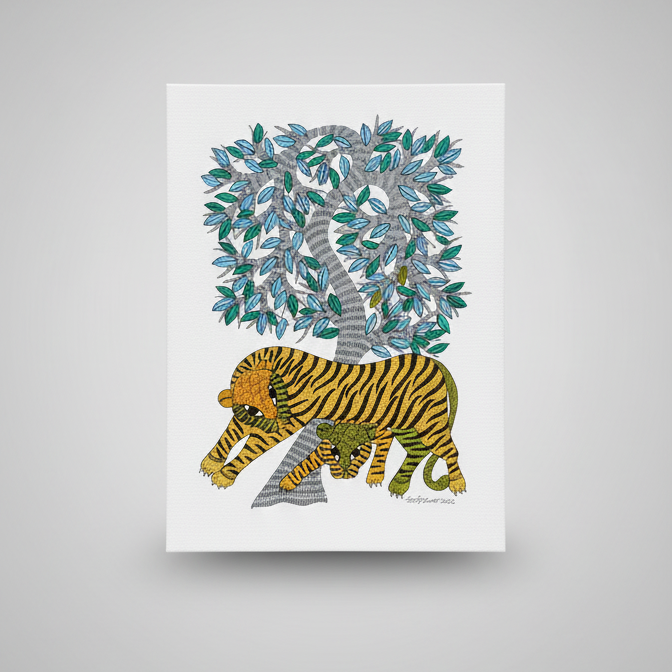
Pattachitra Mandala – Radha-Krishna with Narrative Medallions (Framed)

Handcrafted By
Niranjan MoharanaComposed like a cosmic diagram, this Pattachitra mandala sets Radha and Krishna at the center of a world turning in devotion. The core shrine—a lotus-cusped alcove alive with garlands, pillars, and a beaded halo—holds the divine pair in poised intimacy. Around them, two circular garlands of medallions unfold like a rosary, each bead a complete miniature: dances under moonlight, playful thefts of butter, serpent conquest, pastoral processions, blessings granted to devotees. Beyond the rings, rectangular panels extend the narrative: villages, temples, musicians, sages, and riverside episodes that read like memory fragments stitched into cloth. The result is a portable cosmos—a map where theology, festival, and domestic life orbit a love that Indian aesthetics treats as the measure of reality.
The mandala format is more than design; it is a discipline of looking. At a glance, the concentric rings gather the eye and steady it; as you move closer, each medallion demands attention, and you learn to cycle between whole and part without haste. This is the grammar of Pattachitra: repetition with variation, micro-detail within strong geometry, ornament as breath. The painter has built the surface from natural pigments—emerald greens, lac reds, turmeric yellows, and deep indigo—over a polished cotton ground prepared with tamarind-seed and chalk size. Conch-white and lampblack are returned to last, to lace edges, bead jewelry, and drop the precise dots that give the entire field a soft, starry shimmer.
Borders act as both frame and chorus. Closest to the image is a chain of lotus petals; beyond it a band of patterned tiles; then floral creepers and bead fillets, their rhythms calibrated so that nothing feels fussy or still. Corners bloom into cartouches, and a slim turquoise line retunes the palette between warmer reds and golds. Even the negative spaces—tiny dark wells carved between medallions—are designed, each a pause in the sentence of the whole. The outer square asserts stability; the inner circles spin stories; together they dramatize the Indian intuition of order within movement.
Iconographically, Krishna and Radha are not merely centered; they are enthroned as the axis mundi. Krishna’s flute tucks into the curve of his body, a promise of music more than its sound; Radha’s posture—graceful yet grounded—balances him, their silhouettes rhyming like raga and tala. Jewels are not painted as flat patches but constructed from dots and hairlines so that they flicker like inlay. The painter borrows textile vocabularies—ikat checks, brocade butas, applique scallops—to build garments that feel woven. The floral canopy above the pair is dense without heaviness, and the pedestal underneath is a miniature architecture of arches and tiles that anchors the mandala’s lyricism in craft.
This work is about abundance directed by measure. There are dozens of figures, yet the composition never loses breath. That is because the artist respects intervals: blank slivers of conch-white around the central shrine, quiet bands between rings, and regular returns to a cooling green after warm passages. The eye is choreographed: first to the center, then around the inner ring, then out to the square, then back. In this way the painting enacts its subject—love as the movement that makes a world—without a single written word.
Placed in a contemporary interior, the mandala is a sovereign conversation piece. The square format sits beautifully over a console or between windows; the jewel palette warms neutral rooms and harmonizes with dark woods. Because the surface is dense with detail, it rewards proximity: hang it where a viewer can step close and linger. Under soft light the conch-white rekha glows; under morning light the gem colors breathe. In a pooja space it becomes a calendar of stories; in a living room it becomes a secular hymn to attention, craft, and joy.
Conservation is straightforward. Use UV-protective glazing and acid-free mounts; avoid direct sunlight and dampness; dust the surface of the glazing with a soft cloth. Should you reframe, float a slightly deeper mount so the medallion relief—those tiny raised white dots—has room to breathe. As a hand-painted work, minute irregularities—an extra bead, a thickened hairline—are signatures, not flaws. They are where the workshop’s time meets yours: the painter’s hours beading borders becoming your minutes of discovery at the wall.
The longer one lives with a mandala like this, the more it reveals: the way a shepherd’s crook echoes a flute curve two rings away; how a lotus petal at north answers a garland at south; how a cow’s gentle eye and a temple bell share the same dot vocabulary. Such correspondences teach the viewer to read pattern as thought. That is why Pattachitra has endured—not simply as decoration, but as a pedagogy of seeing. In this painting Radha and Krishna are less characters than principles: presence and response, melody and rhythm, center and circumference. Around them, village, forest, and river learn their steps; in front of them, so do we.
Niranjan Moharana
Niranjan Moharana is a highly acclaimed artist and National Awardee based in the Puri district of Odisha, India. His exceptional talent lies in his mastery of the traditional Pattachitra artwork, a form of art that originated in the state of Odisha.Niranjan's Pattachitra artwork is truly spectacular, featuring vibrant and intricate depictions of various mythological themes. These themes include depictions of the local deity Jagannath, as well as Ganesha dancing in Krishna's pose, Radha and Krishna, nature, and animals representing the incarnations of Vishnu.The Pattachitra art form is known for its use of natural dyes and handmade papers, which give each piece a unique and organic feel. Niranjan's expertise in this traditional art form has earned him widespread recognition and appreciation from art lovers and collectors alike.Niranjan's dedication to preserving the traditional Pattachitra artwork has also led him to train and mentor younger artists, ensuring that this beautiful art form continues to thrive for generations to come.Through his stunning artwork, Niranjan Moharana has not only put Puri district and Odisha on the map but has also helped to preserve and promote the rich cultural heritage of India.
View Artisan's Workshop & Collection arrow_forward100% Handcrafted
Made with time-honored traditional techniques by certified Indian master artisans.
Authentic Materials
Genuine natural materials sourced responsibly from indigenous Indian craft clusters.
Fair Trade Impact
Every purchase directly supports the livelihoods of traditional artisan families.
| Craft / Category | Paintings |
|---|---|
| Master Artisan | Niranjan Moharana |
| Material | Natural stone & vegetable pigments on hand-primed cotton (traditional Pattachitra) |
| Color | Emerald, vermilion, turmeric, indigo, rose, conch-white, lampblack |
| Dimensions (L x W x H) | N/A x N/A x N/A cm |
| Weight | N/A g |
| Brand / Cluster | Artisan |
| SKU / Item Code | SKU-64 |
| Country of Origin | India |
No reviews yet. Be the first to share your thoughts!
Write a Review
Please log in to write a review.
Log InYou May Also Like
View All